Hill Climb Racing Physics: How the Engine Works and Why Your Car Keeps Flipping
Hill climb racing physics is the real reason this game is still played by 4 million people every day in 2026. Not the graphics. Not the sound. The physics. You tap the gas, hit a steep hill, and your vehicle either climbs or flips. That split second is the whole game. Most players blame their vehicle when they flip. The real problem is not understanding what is actually happening under the hood of the physics engine. The physics engine is what 4 million players come back to every single day. Get it. Use it.
Hill Climb Racing Physics: Real Facts, Numbers and Data You Need to Know First
Before anything else, the numbers that prove why this physics engine matters.
| Stat | Data | Source |
|---|---|---|
| Total HCR1 downloads | 2 billion (January 15, 2026) | Fingersoft CEO Teemu Narhi official statement |
| Daily active players | 4 million worldwide | Fingersoft official, January 2026 |
| Game release date | September 22, 2012 | Fingersoft / Wikipedia |
| Developer | Toni Fingerroos, Fingersoft, Oulu, Finland | Wikipedia |
| Physics system type | Custom 2D rigid body simulation | Fingersoft App Store description |
| Full franchise downloads | Close to 3 billion across all versions | NordiskPost, January 2026 |
| Google Play rating | 4.23 out of 5 from 10.8 million reviews | AppBrain, 2026 |
| Developer description | “One of a kind in-game physics system” | Apple App Store, Fingersoft |
Toni Fingerroos spent 16 hours a day for several months building this game alone in a compact bedroom in Oulu, Finland. The physics engine he built from scratch became the reason critics called the game “furiously addictive” even while dismissing the graphics as rudimentary.
How Does the Physics Engine Work in Hill Climb Racing?
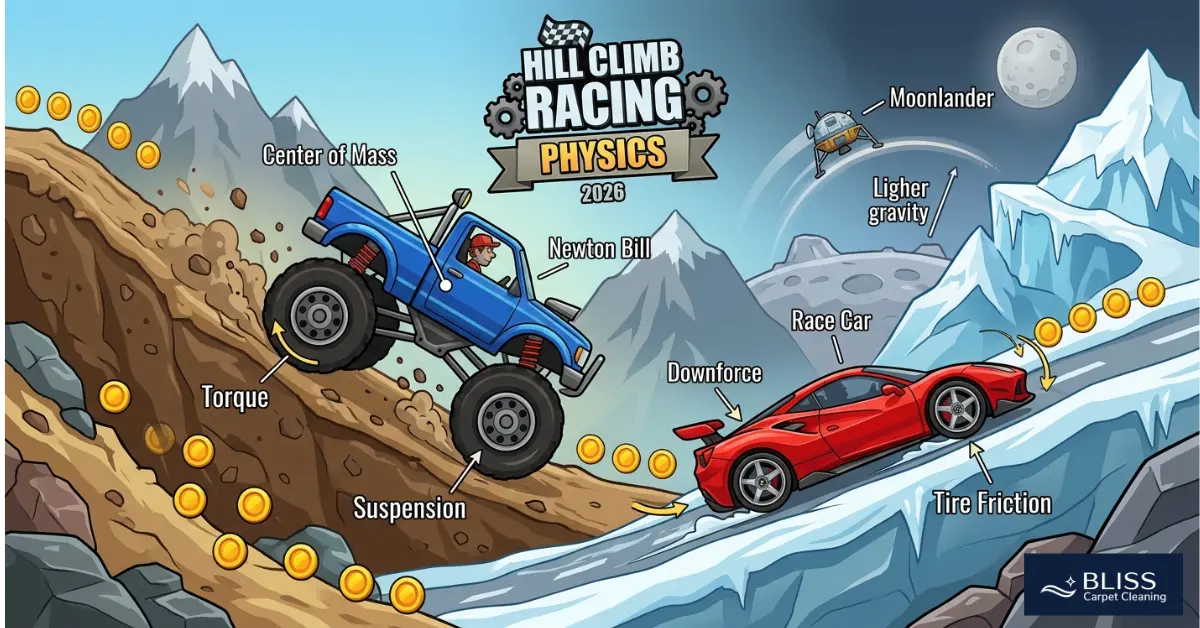
Hill climb racing physics runs on a custom 2D rigid body simulation. Fingersoft built it specifically for this game. It is not a generic off-the-shelf engine. Every vehicle is treated as a rigid body object with mass, a defined center of mass, wheel contact points, and torque output from the engine.
The terrain is a series of connected surface points. When your vehicle wheels touch those points, the engine calculates normal force, friction, and the resulting acceleration or deceleration in real time. That is why the game feels different on a flat road versus a steep hill versus ice versus low gravity.
Two buttons control everything: gas and brake. But what those buttons actually do is apply rotational torque to the wheels. That torque transfers to the ground through friction. If friction is high enough, the vehicle moves forward. If the torque exceeds what friction can handle, the wheels spin and grip is lost.
The suspension connects the wheels to the body separately. When you hit a bump, the wheel absorbs the impact first, then the suspension transfers a reduced force to the body. Upgrade your suspension and that transfer becomes smoother. Leave it at level one and every bump punches the body directly.
The game applies continuous gravity to every object. The value changes per stage. Moon and Mars reduce it. Arctic keeps it normal but strips surface friction instead. The stage-by-stage breakdown below shows exactly how each one differs.
One more thing most players never realize. When your vehicle is airborne, the gas and brake pedals stop controlling wheel torque. Instead, they apply angular momentum directly to the vehicle body. That is the air control system.
Monster Truck
Center of Mass:
High
High Risk
Tall body, heavy build
Tank
Center of Mass: High
High Risk
Cannon and turret push mass upward
Jeep
Center of Mass: Medium
Medium Risk
Balanced but sensitive on steep hills
Rally Car
Center of Mass: Low-Medium
Medium Risk
Low grip stat causes slide-flips
Three physics-based fixes that actually work:
Throttle Feathering
Tap the gas instead of holding it on the way up — the same technique covered in detail in our Hill Climb Racing tips guide.
Upgrade Tires First on Ice Stages
On Arctic, the flip is not caused by throttle. It is caused by near-zero friction between rubber tires and ice. Upgrading tires changes the friction coefficient in the physics simulation — exactly why our Arctic stage guide puts tires as the first upgrade priority.
Use Air Control on Every Landing
Landing nose-first adds angular momentum in the forward rotation direction. The vehicle keeps rotating. It flips forward. Landing flat cancels that momentum. Air control gives you that landing angle.
Why Does My Car Keep Flipping in Hill Climb?
This is the most asked physics question in the entire game. The answer is center of mass combined with throttle input.
Every vehicle has a center of mass at a specific height above the ground. Tall vehicles like the Monster Truck and Tank have a high center of mass. Low vehicles like the Race Car and Rally Car have a low center of mass. The higher the center of mass, the less force it takes to tip the vehicle past its tipping point.
When you hold full throttle on a steep uphill, the engine applies torque to the rear wheels. That torque generates a rotational force around the rear axle. If the hill is steep enough and your throttle input is high enough, the front wheels lift off the ground. Once they leave the ground, you have no steering input and no front traction. The vehicle continues rotating backward. Newton Bill meets the dirt.
Here is the flip tendency by vehicle type:
Rigid Body Simulation
Every vehicle has mass, center of mass, wheel contact points, and torque output. All calculated in real time.
Torque and Friction
Gas and brake apply rotational torque to the wheels. Torque transfers to the ground through friction. No friction — no movement.
Variable Gravity
Gravity changes per stage. Moon and Mars reduce it. Arctic keeps it normal but strips surface friction instead.
Suspension Transfer
Wheels absorb impact first, suspension transfers reduced force to the body. Upgrade suspension to smooth this transfer.
How Does Gravity Affect Different Stages In this Game?
Gravity in Hill Climb Racing is not the same on every stage. Fingersoft adjusts the gravity constant per stage as part of the physics simulation. This is one of the least talked about but most impactful differences between stages.
On standard stages like Countryside, Desert, Highway, and Cave, gravity runs at the normal game baseline. Your vehicle behaves predictably. Hills require torque. Downhills accelerate you. Jumps follow expected arcs.
Moon stage cuts gravity significantly. This is not a cosmetic change. The physics simulation applies a lower downward force to every object on that stage. The result is longer air time on every jump, slower falling speed, and reduced wheel contact pressure on landing. Less contact pressure means less friction. Less friction means lighter traction even on flat ground. That is why the Moonlander’s low-pressure tires were specifically designed for this stage.
| Stage | Gravity Level | Traction Impact | Key Physics Challenge |
|---|---|---|---|
| Countryside | Normal baseline | Full traction | Throttle control on steep hills |
| Highway | Normal baseline | Full traction | Speed management at high velocity |
| Moon | Significantly reduced | Reduced contact pressure | Air time control, landing angle |
| Mars | Reduced plus ceiling | Reduced plus ceiling constraint | Big jumps hit ceiling, stay low |
| Arctic | Normal | Near-zero on ice | Friction coefficient near zero |
| Alien Planet | Similar to Moon | Reduced | Extended air time, flip bonuses |
| Cave | Normal | Full traction | Ceiling clearance, downforce matters |
Mars is the most punishing physics combination. Low gravity means your jumps go high. A ceiling means going high kills your run. The physics problem is the opposite of Moon. On Moon you want to stay airborne. On Mars you want to stay grounded. For the full Moon physics breakdown including fuel can placement and farming numbers, check our Moon stage guide.
Arctic deserves a separate mention. Gravity stays normal.The physics problem is pure friction.. Ice has a friction coefficient near zero in the simulation. Your wheels spin freely. Traction is minimal. The solution is upgrading tires before engine, which changes the friction value the physics engine uses at the contact points.
How Do Vehicle Upgrades Change the Physics Behavior in Hill Climb Racing Mod APK?
Most players think upgrades just add numbers to a stat bar. They do not. Each upgrade category changes a specific variable in the physics simulation.
Engine upgrade increases the torque output applied to the drive wheels. More torque means more force against the ground. On steep hills, more engine torque is the difference between climbing and stalling. It does not change grip. It does not change the center of mass. It changes output force only.
Tire upgrade changes the friction coefficient at the wheel-ground contact point. Higher friction means less wheel slip. On ice, this is the single most important upgrade because the baseline friction is near zero. On normal terrain, better tires mean your engine torque transfers more efficiently to forward movement instead of wheel spin.
Suspension upgrade changes how landing impulse transfers from the wheels to the body. A level 1 suspension passes most of the impact force directly to the body. This jolts the vehicle, disrupts the center of mass position, and triggers flips. A maxed suspension absorbs the impulse gradually, keeping the body stable through hard landings.
4WD upgrade distributes drive torque across all four wheels instead of just the rear two. On slippery terrain this matters because more contact points sharing the torque load means less chance of individual wheel spin.
Downforce upgrade adds an aerodynamic downward force that scales with speed. At low speed it does almost nothing. At high speed on a vehicle like the Race Car or Rally Car it pushes the body toward the ground, increasing contact pressure and therefore increasing effective traction. This is why downforce vehicles dominate Cave stage.
Engine | Drive wheel torque output | More climbing power on steep hills |
Tires | Friction coefficient at contact | Less slip, better grip on all terrain |
Suspension | Landing impulse absorption rate | Smoother landings, less bounce-flip |
4WD | Torque distribution across axles | Even traction on all four wheels |
Downforce | Aerodynamic downward force at speed | Body press at high velocity, better traction |
Players who want the full upgrade order from a progression standpoint can find it in our beginner guide.
How Does Air Control Work When Your Vehicle Is In Mid-Air?
Air control is the most misunderstood mechanic in hill climb racing physics. Most new players do not even know it exists.
When all four wheels leave the ground, the physics engine switches the gas and brake pedals from torque application to angular momentum application. Gas now rotates the vehicle nose-down. Brake rotates the vehicle nose-up. The speed of rotation depends on vehicle mass and moment of inertia. Light vehicles like the Motocross Bike rotate fast. Heavy vehicles like the Tank rotate slowly.
Gas Pedal Mid-Air
Rotates Nose Down
Use before landing on uphill slopes to match terrain angle and avoid forward flip on impact.
Brake Pedal Mid-Air
Rotates Nose Up
Use before landing on downhill slopes. On Moon, experienced players land rear-first after each hill.
The angle at which your vehicle contacts the ground determines what happens next.
Landing nose-first applies force in a forward-rotating direction. The vehicle wants to continue that rotation. If the hill slopes up at the landing point, this becomes a forward flip. If the road is flat, it becomes a hard bounce that destabilizes the run.
Landing flat — parallel to the slope angle — spreads the impact force evenly across all contact points. The suspension handles the impulse. The vehicle stays stable and moves forward.
Landing rear-first on a downhill is actually fine. The rear wheels absorb first, the suspension compresses, and the vehicle continues moving. On Moon stage, experienced players use brake mid-air to tilt the nose up, landing rear-first on the downward slope after each hill.
The neckflip happens when the vehicle rotates so far mid-air that the driver’s head nearly reaches the ground on landing. This is a specific angular rotation threshold in the physics simulation. It pays 2,500 coins because it is genuinely risky. If your rotation goes slightly past the neckflip angle, Newton Bill’s head hits the ground and the run ends.
Players who want to apply this in long distance sessions will find the exact techniques tested in our distance tips guide.
How Different Vehicles Use Physics Differently? Know here
Not every vehicle uses the same physics rules. Three differences matter most.
Center of mass height. The Monster Truck and Tank both have a high center of mass because their body mass sits far above the wheel axles. Any rotational input hits the tipping point faster. The Race Car and Rally Car sit low. Their center of mass stays close to the axle height. They are harder to tip but easier to slide sideways on low-friction surfaces.
Softbody physics on rear wheels. The Dragster and Race Car are the only two standard vehicles with softbody physics applied to the rear wheel. This means the rear tire physically deforms under load. Watch either vehicle on a fast Highway run and you can see the rear tire compress and deform under load. No other standard vehicle does this. It affects how torque transfers to the ground at high speed.
Tracked versus rubber tires. The Tank and Super Offroad run tracked systems instead of wheels. Tracks distribute contact force across a wider surface area. This increases the effective friction contact zone significantly. On ice stages like Arctic and Arctic Cave, the difference between gripping the surface and sliding completely comes down to contact area alone.
The Moonlander adds one more unique physics element. Its thrusters apply direct force to the body, bypassing the wheel-ground system entirely. Traction becomes irrelevant during thruster use. The vehicle moves through direct force application, not friction. The full thruster physics, including fuel burn rates and the semi-AFK farming trick, are covered in our Moonlander guide.
How to Use Hill Climb Racing Physics to Your Advantage
Understanding physics is useless unless you apply it. Four practical techniques that come directly from how the engine works.
Throttle Feathering on Inclines
Tapping the gas in short bursts keeps torque below the front-wheel-lift threshold. You climb the hill without triggering the rotational force that causes backward flips. This also burns less fuel because you spend less time at maximum torque output.
Momentum Conservation on Downhills
Release the gas completely on steep downhills. Gravity does the work for free. Your vehicle accelerates without burning fuel. Saved fuel means longer runs. The physics pays you for doing less.
Parallel Landing Every Time
Use air control to match your vehicle’s nose angle to the slope angle at your landing point. Parallel landing means the physics engine distributes impact force evenly. No bounce, no flip, no destabilization. This one technique changes distance performance more than any single upgrade below level 5.
Pitch Control Through Corners
On stages with sudden direction changes like Cave and Roller Coaster, brake before the slope change, not during it. Braking during a direction change shifts the center of mass forward, increasing flip risk. Braking before the change bleeds speed while the center of mass stays balanced.
Players chasing distance records will find how these physics techniques connect to specific stage strategy in our Hill Climb Racing strategies guide.
Frequently Asked Questions
What is the difference between Hill Climb Racing physics and real-world physics?
Hill Climb Racing uses a custom 2D rigid body simulation, not real-world physics equations. Fingersoft themselves describe it as having “little respect to the laws of physics.” Fingersoft kept gravity, friction, and torque but tuned each one for fun and challenge instead of accuracy. The result is physics that feel intuitive and learnable but would never pass an engineering exam.
Does the suspension upgrade actually affect how the vehicle handles?
Yes, directly. Suspension changes how landing impulse transfers from the wheels to the vehicle body. At level 1, most impact force passes straight through to the body, jolting it and disrupting stability. At higher levels, the system absorbs that force gradually, giving you cleaner landings with less speed loss after every jump.
Why does the Moon stage feel so different to drive?
Fingersoft reduces the gravity constant on Moon stage compared to standard stages. Lower gravity means your vehicle spends more time airborne, lands with less force, and experiences reduced wheel contact pressure. Less contact pressure means less traction even on flat sections, which is why Moon demands air control skills that Countryside simply does not require.
How does vehicle weight affect flipping and distance?
Heavier vehicles have a higher moment of inertia, meaning they resist rotation more. This makes unintended flips less likely but also makes mid-air correction slower. Lighter vehicles rotate fast in the air, which makes flip chains easier but raises the risk of accidental over-rotation. On fast flat stages like Highway, lighter vehicles also burn less fuel per meter, extending total distance.
What role does traction play in Hill Climb Racing physics?
Traction is the friction force between your tires and the ground surface. It determines how much engine torque actually moves the vehicle forward versus spinning the wheels uselessly. On ice stages, traction drops to near zero at the baseline. Tire upgrades raise the friction coefficient the physics engine applies at each contact point, directly improving how efficiently torque becomes forward movement.
How does momentum work in Hill Climb Racing?
Momentum in HCR works as mass multiplied by velocity. On downhills, your vehicle builds momentum from gravity without burning fuel. That momentum carries you up the next hill for free. Releasing the gas on downhills and using built-up speed to climb the next rise is the most fuel-efficient driving technique in the game and it is pure physics.
Why does the same upgrade level feel different on different vehicles?
Each vehicle has different base values for mass, center of mass height, and friction coefficient. Engine level 4 applies the same torque increase to both the Jeep and the Monster Truck. But because the Monster Truck is heavier and sits higher, the same torque produces different observable results. The physics input is equal. The output differs because each vehicle’s base properties are different.
How does downforce affect vehicle stability in Hill Climb Mod?
Downforce adds an aerodynamic downward force that scales with vehicle speed. At low speed it contributes almost nothing. At high speed it pushes the body toward the ground, increasing contact pressure on the tires and raising effective friction. This is why downforce vehicles like the Race Car and Rally Car handle steep descents at speed far better than vehicles without it.
Does tire upgrade improve grip and physics handling in this Racing Game?
Yes. Tire upgrades change the friction coefficient value the physics engine applies at each wheel contact point. Higher friction means wheel torque converts to forward movement more efficiently instead of spinning uselessly. On icy terrain this upgrade outperforms engine upgrades because the baseline friction value is near zero and raw torque power changes nothing without grip.
How does the center of mass affect vehicle behavior?
The center of mass determines how much rotational force is needed to tip a vehicle past its tipping point. A high center of mass requires less force to initiate a backward flip on a steep hill. A low center of mass requires more. This is why the Monster Truck and Tank flip more easily on inclines than the Race Car and Rally Car, even at identical upgrade levels and identical throttle inputs.